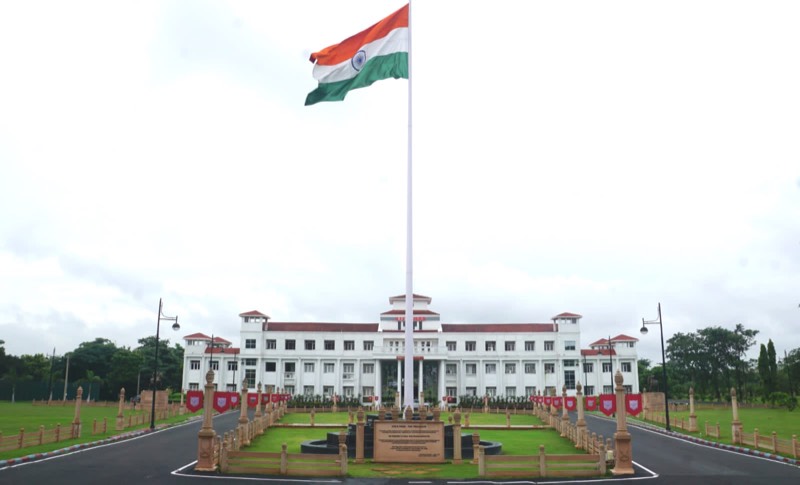
1. Who Is OTA Women SSC?
OTA Women SSC (Non-Technical) is the female officer entry to the Indian Army through the CDS examination. Officers are commissioned at OTA Chennai and serve in Short Service Commission (SSC) roles across non-combat branches.
CDS I 2025 vacancies: 18 posts (OTA SSC Women, Non-Technical)
Training: OTA Chennai — same campus as male SSC entrants; 49-week training course.
Branches eligible for women: Corps of Engineers, Corps of Signals, Army Service Corps, Army Ordnance Corps, Army Educational Corps, Intelligence Corps, Judge Advocate General (JAG) Branch, Army Air Defence (selected roles).
OTA Women SSC is one of the most competitive entries — only 18 vacancies for CDS I 2025 across all India. The written exam cutoff for women is typically higher than for male OTA candidates.
2. Eligibility — Age, Marital Status & Education
Source: CDS 2025 Notification para 3(b)(v), page 7.
| Parameter | Requirement |
|---|---|
| Age range | 19–25 years |
| DoB window (CDS I 2025) | 02 Jan 2001 to 01 Jan 2007 |
| Marital status | Unmarried women OR issueless widows (not remarried) OR issueless divorcees (with divorce documents) |
| Education | Any degree from a recognised university |
| Nationality | Indian (women of Indian origin may apply per general CDS eligibility) |
Unlike IMA, INA, AFA, and OTA Men (which require "unmarried males"), OTA Women SSC is open to issueless widows and issueless divorcees in addition to unmarried women. "Issueless" means without dependent children.
Marriage restriction: Candidates must remain unmarried throughout training. Marrying during training leads to discharge and liability to refund government expenditure.
3. Height & Weight
Minimum height: 152 cm. No maximum height is stated in the CDS notification.
In feet: 152 cm ≈ 5 ft 0 in; 148 cm ≈ 4 ft 10 in.
Regional Height Relaxations
Source: CDS 2025 Notification para 7(c).
| Category | Female OTA Women (Army) |
|---|---|
| Tribals from Ladakh | 150 cm |
| Andaman & Nicobar / Lakshadweep / Minicoy | 150 cm |
| Gorkhas, Nepali, Assamese, Garhwali, Kumaoni, Uttarakhand | 148 cm |
| Bhutan, Sikkim & North-East Region | 148 cm |
The Army notification uses 148 cm for female Gorkha/NE region candidates (vs 147 cm used in the Navy Annexure). Both figures are correct for their respective services — 148 cm is the Army figure and applies to OTA Women.
Weight & Overweight Exception
The same DGMS Aug 2019 chart applies — female weight-for-height column at age 20–25. No separate female weight table appears in the CDS notification; reference the DGMS Aug 2019 female column.
Overweight exception conditions: BMI < 25, Waist-Hip Ratio < 0.8 (female), Waist circumference < 80 cm (female), national-level body-building/sports documentation, normal biochemicals.
Chest Measurement
77 cm minimum with 5 cm expansion (same as male candidates).
4. Gynaecological Examination Procedure
The gynaecological examination is mandatory for all female candidates. It is conducted exclusively by a Lady Medical Officer (LMO) or Lady Gynaecologist in a private examination setting. A male medical officer cannot conduct this examination.
Key Procedural Points
- Examined by Lady Medical Officer or Lady Gynaecologist only
- Detailed history recorded: menstrual history, obstetric history, gynaecological history
- Speculum and PV (per-vaginum) examination are NOT performed on unmarried candidates
- Ultrasound abdomen + pelvis: mandatory for all female candidates
- Breast examination: included in the gynaecological board
- All other examinations (vision, ENT, MSK, dental, etc.) follow the same standards as male candidates
Timing note: Candidates who are menstruating on the date of the medical board should inform the Lady MO. The examination may be rescheduled by 1–2 days in cases of heavy bleeding, but generally proceeds normally.
5. Gynaecological Disqualifying Conditions
| Condition | Status |
|---|---|
| Primary amenorrhoea | Unfit |
| Secondary amenorrhoea | Unfit |
| Severe menorrhagia | Unfit |
| Severe dysmenorrhoea | Unfit |
| Stress urinary incontinence | Unfit |
| Congenital elongation of cervix or prolapse outside introitus (even post-correction) | Unfit |
| Pregnancy at time of medical board | Cause for Rejection |
| Complex ovarian cyst (any size) | Unfit |
| Simple ovarian cyst > 6 cm | Unfit |
| Endometriosis | Unfit |
| Adenomyosis | Unfit |
| Submucous fibroid (any size) | Unfit |
| Broad ligament / cervical fibroid causing ureter pressure | Unfit |
| Single fibroid > 3 cm | Unfit |
| > 2 fibroids (any size) | Unfit |
| Fibroids distorting uterine cavity | Unfit |
| Congenital uterine anomaly (except arcuate) | Unfit |
| Acute / chronic pelvic infection | Unfit |
| Disorders of sexual differentiation | Unfit |
| Significant hirsutism + male-pattern hair growth + radiological PCOS on USG | Rejection |
6. Acceptable Gynaecological Conditions
| Condition | Status |
|---|---|
| Unilocular clear ovarian cyst ≤ 6 cm | Acceptable |
| Minimal fluid in Pouch of Douglas | Acceptable |
| Arcuate uterus | Acceptable |
| Congenital elongation of cervix up to introitus | Acceptable |
| Single small fibroid uterus ≤ 3 cm, asymptomatic | Acceptable |
An ovarian cyst found on USG is one of the most common reasons for female candidate rejection. If you know you have a cyst, get it evaluated well before the SMB — many functional cysts resolve on their own or with treatment.
7. Post-Surgery Recovery Timelines
| Surgery / Condition | Minimum Recovery Before SMB |
|---|---|
| Laparoscopic cystectomy / myomectomy | 12 weeks — asymptomatic, normal post-op USG, benign histopathology, no endometriosis at operation |
| Laparotomy (open abdominal surgery) | 1 year |
| Post-vaginal delivery | 24 weeks after delivery |
| After MTP / abortion | 4–12 weeks |
| Post-Caesarean section | 52 weeks (unfit for 1 year; then re-examination) |
| Fibroadenoma (breast) — after surgical removal | Fit with surgeon's opinion + normal histopathology |
8. Breast Examination
- Any breast lump → cause for rejection. Fibroadenoma after successful removal may be declared fit if supported by surgeon's opinion and normal histopathology.
- Galactorrhoea → temporary unfitness; fit after investigation and successful treatment.
- Amazia (absent breast), Polymazia (extra breast), Polythelia (accessory nipple) → unfit.
- Gynaecomastia (excess glandular breast tissue) → reconstructive surgery may restore fitness; fit 12 weeks post-op if healed, no residual disease, and normal endocrine workup.
9. PCOS — What It Means for Your Medical
Polycystic Ovary Syndrome (PCOS) is not an automatic disqualifier — but significant hirsutism combined with radiological evidence of PCOS is.
What Is Disqualifying
- Significant hirsutism with male-pattern hair growth + radiological PCOS on USG → Rejection
- "Significant hirsutism" means hair growth in male distribution patterns (face, chest, abdomen) beyond normal female variation, typically assessed by a modified Ferriman-Gallwey scale.
What Is NOT Automatically Disqualifying
- Mild PCOS without significant hirsutism
- Irregular periods without other clinical signs
- PCOS-related acne at Grade I (face only)
Practical Advice
- If you have PCOS, consult an endocrinologist well before your SMB.
- Treat hirsutism dermatologically (laser hair reduction) well before the medical board.
- Manage weight within the DGMS chart — PCOS-related obesity is a compounding factor.
- The gynaecologist at the SMB makes a holistic clinical assessment; there is no single absolute test for PCOS severity.
10. Vision, ENT, Dental & MSK (Same as Army)
The following standards are the same as male Army graduate entries (DGMS Aug 2019 graduate-entry column). There is no separate female concession for these parameters.
Vision
| Parameter | Requirement |
|---|---|
| Uncorrected visual acuity (each eye) | 6/60 |
| Best corrected visual acuity (BCVA) | 6/6 in each eye |
| Myopia limit | ≤ −3.5 D Sph |
| Hypermetropia limit | ≤ +3.5 D Sph |
| Astigmatism | ≤ ±2.0 D Cyl |
| Colour perception | CP-II |
| LASIK | Permitted (minimum 12 months post-surgery, under 8 conditions) |
ENT
- Whisper hearing at 610 cm (each ear separately)
- No active Otitis Media
- No Allergic Rhinitis
Dental
- Minimum 14 dental points required
Musculoskeletal (MSK)
- Knock knees: Intermalleolar distance > 8 cm renders a female candidate unfit (more relaxed than the male threshold of 5 cm)
- Flat feet: Supple arches that reappear on toe-standing may be fit; rigid flat feet → unfit
11. Frequently Asked Questions
Can a divorced woman apply for OTA Women SSC?
Yes. OTA Women SSC is uniquely open to unmarried women, issueless widows (not remarried), and issueless divorcees (with divorce documents). "Issueless" means without dependent children.
Male candidates in OTA/IMA cannot use this exception — a male divorcee or widower is NOT treated as an unmarried male for any CDS academy.
What is the minimum height for OTA Women?
The minimum height is 152 cm. Regional relaxations apply:
- 148 cm for Gorkha, Assamese, NE region, Bhutan, Sikkim, and Uttarakhand hills candidates
- 150 cm for Ladakh tribals and Andaman & Nicobar / Lakshadweep candidates
These figures are from the Army CDS notification. The Navy uses 147 cm for the same NE categories — Army uses 148 cm for OTA Women.
I have PCOS. Will I be rejected from OTA Women?
Not automatically. The disqualifying finding is "significant hirsutism with male-pattern hair growth AND radiological PCOS on ultrasound." Mild PCOS without significant hirsutism is not listed as an automatic disqualifier.
The gynaecologist at the SMB makes a clinical assessment. If you have PCOS, consult an endocrinologist, manage symptoms, and seek a pre-board gynaecological opinion to understand your specific situation.
Is a PV examination (internal examination) done for unmarried OTA Women candidates?
No. Speculum and per-vaginum (PV) examination are NOT performed on unmarried candidates.
The gynaecological assessment for unmarried women consists of detailed history-taking, abdominal examination, and mandatory ultrasound abdomen + pelvis. The examination is conducted by a Lady Medical Officer or Lady Gynaecologist only.
I had an ovarian cyst removed laparoscopically 6 weeks ago. Can I appear for OTA Women SMB?
No, not yet. The minimum recovery period after laparoscopic cystectomy is 12 weeks (3 months).
You must also be asymptomatic, have a normal post-op ultrasound, benign histopathology report, and no evidence of endometriosis on operative findings. Carry your complete operative notes and histopathology report to the SMB.
What are the vision requirements for OTA Women?
Same as male Army graduate entries: uncorrected vision 6/60, best corrected visual acuity 6/6 in each eye, myopia ≤ −3.5 D Sph, hypermetropia ≤ +3.5 D Sph, astigmatism ≤ ±2.0 D Cyl, colour perception CP-II.
LASIK is permitted under 8 conditions including minimum 12 months post-surgery. There is no special female vision concession — the standard is the same as for male IMA/OTA candidates.
I am a widow with one child. Am I eligible for OTA Women SSC?
No. The eligibility is for issueless widows — meaning without children. Having one child (or more) makes you ineligible under the current CDS notification.
If you have remarried, you are also ineligible (only widows "not remarried" are eligible). These conditions are strictly verified at the time of document check at SSB and medical board.
Will my irregular periods affect my OTA Women medical result?
It depends on severity. Secondary amenorrhoea (cessation of periods) is explicitly disqualifying. Severe menorrhagia (heavy bleeding) and severe dysmenorrhoea (painful periods requiring medical treatment) are disqualifying.
Mild irregularity without an underlying pathological cause may not be disqualifying — the gynaecologist assesses clinically. Maintain honest menstrual history in your AFMSF-2 form.
Can a pregnant woman appear for OTA Women SMB?
No. Pregnancy is a cause for rejection at the time of the medical board. CDS/OTA Women candidates must not be pregnant at the time of the SMB.
Candidates who become pregnant after notification of SSB but before the medical board will be rejected at the SMB.
I have a small fibroid (2.5 cm) found on an ultrasound. Can I join OTA Women?
Possibly yes. A single small fibroid uterus ≤ 3 cm that is asymptomatic is listed as an "acceptable" condition.
However, if the fibroid is > 3 cm, or there are more than 2 fibroids, or fibroids distort the uterine cavity, or if it is a submucous fibroid — all of these are disqualifying. A 2.5 cm single intramural fibroid that is asymptomatic and does not distort the cavity may be accepted at the gynaecologist's discretion. Get a detailed USG report before the SMB.