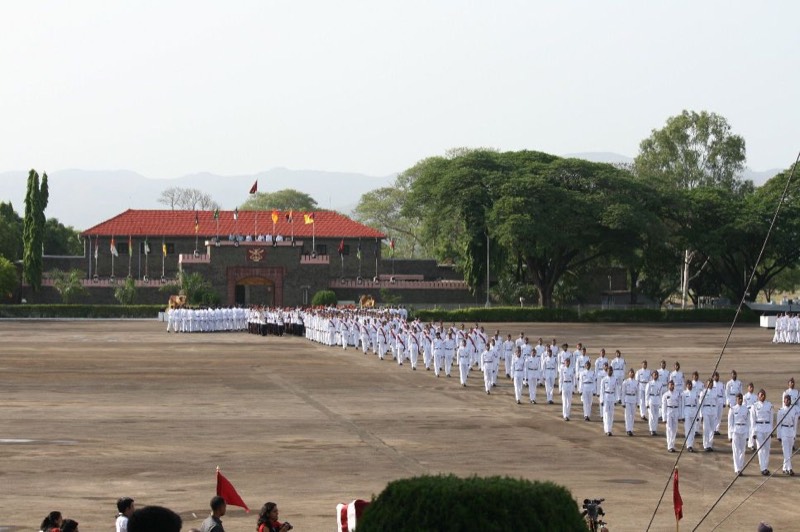
1. NDA Army Wing — Overview
The NDA Army Wing (also called NDA entry — as distinct from NA for Naval Academy and Air Force Wing) commissions officers into the Indian Army through the Permanent Commission route after NDA. Candidates are 16–19 year old school-leavers (Class 12 or appearing).
- Medical standard: DGMS Army Aug 2019 — 10+2 / NDA entry column (stricter than graduate IMA column)
- Source: NDA 2025 Notification Annexure A (pages 32–40)
- NDA I 2025 Army vacancies: 208 (male; female included from 2022 batch)
- Minimum age at start of course: 16.5 years (born between 2 Jan 2007 and 1 Jul 2008 for NDA I 2025)
NDA Army standards are STRICTER than IMA (CDS graduate entry) on vision — NDA Army allows only −2.5 D myopia and LASIK is NOT permitted. This is because NDA admits 16-year-olds whose eyes may not have stabilised, unlike the 19+ graduate entries.
2. How Army Differs from Navy & Air Force
The three NDA wings share the same examination but have distinct medical standards at the Service Medical Board (SMB). The table below covers the most commonly referenced parameters.
| Parameter | NDA Army | NDA Navy (NA) | NDA Air Force Flying |
|---|---|---|---|
| Uncorrected vision | 6/36 | 6/12 | 6/6 + 6/9 |
| BCVA | 6/6 | 6/6 | 6/6 (hypermetropia) |
| Myopia max | −2.5 D Sph | −1.0 D Sph | NIL |
| Hypermetropia max | +2.5 D Sph | +2.0 D Sph | +1.5 D Sph |
| Astigmatism | ±2.0 D Cyl | ±1.0 D Cyl | +0.75 D Cyl |
| Colour perception | CP-II | CP Pass | CP-I |
| LASIK | NOT permitted | Permitted | Permitted |
| Min. height (male) | 157 cm | 157 cm | 162.5 cm |
| Knock knees (male) | >5 cm → unfit | <5 cm acceptable | >5 cm → unfit |
| Dental | 14 points | 14 points | 14 points |
Source: NDA & NA 2025 Notification Annexure A · DGMS Army Aug 2019
NDA Army does NOT permit LASIK — unlike IMA/OTA via CDS (which do). If your vision is correctable but you want to join the Army, CDS after graduation may be your route (−3.5 D limit, LASIK permitted).
3. Vision Standards (Army)
Source: NDA Notification Annexure A para 5 (page 34).
| Parameter | NDA Army Standard |
|---|---|
| Uncorrected vision | 6/36 in each eye |
| Best Corrected Visual Acuity (BCVA) | 6/6 in each eye |
| Myopia (max) | −2.50 D Sph (with ±2.0 D Cyl) |
| Hypermetropia (max) | +2.50 D Sph (with ±2.0 D Cyl) |
| Colour perception | CP-II |
| LASIK / refractive surgery | NOT permitted |
Practical Interpretation — Vision vs Wing
| Myopia | NDA Army | NDA Navy | NDA Air Force Flying |
|---|---|---|---|
| −1.0 D | Pass | Borderline (at limit) | Fail |
| −2.0 D | Pass | Fail (exceeds −1.0 D) | Fail |
| −2.5 D | Pass (exactly at limit) | Fail | Fail |
| −3.0 D | Fail (exceeds −2.5 D) | Fail | Fail |
CP-II Colour Perception Explained
CP-II requires Ishihara plate pass and near-normal colour vision. A CP-II candidate can distinguish primary safety colours — sufficient for infantry operations and signal recognition. Testing is done at the SMB using the Ishihara chart. If borderline, the candidate is referred for Anomaloscope testing at the Army Medical Board (AMB).
Visual Disqualifications (Army — same as all wings)
- Manifest squint → unfit
- Keratoconus → unfit
- Night blindness → unfit
- Nystagmus → unfit
- High cup-disc ratio with RNFL defect → unfit
- Progressive pterygium → unfit
4. Height, Weight & Chest
Minimum Height
- Male: 157 cm | Female: 152 cm
- Regional relaxations: 155 cm (Ladakh tribals, A&N Islands); 152 cm (Gorkha, NE, Uttarakhand) — applies to Army and Navy but NOT Air Force Flying
- Growth allowance: +2 cm for candidates below 18 years at time of examination
Chest
- Minimum circumference: 77 cm
- Minimum expansion: 5 cm
- Rounding rules: fractions <0.5 cm ignored; 0.5 cm = 0.5; ≥0.6 cm rounded up
Weight-for-Height (NDA Army, Male, Age 17–20)
| Height (cm) | Min Weight (kg) | Max Weight 17–20 (kg) |
|---|---|---|
| 152 | 41.6 | 53.1 |
| 155 | 43.2 | 55.1 |
| 157 | 44.4 | 56.7 |
| 160 | 46.1 | 58.9 |
| 163 | 47.8 | 61.1 |
| 165 | 49.0 | 62.6 |
| 168 | 50.8 | 64.9 |
| 170 | 52.0 | 66.5 |
| 173 | 53.9 | 68.8 |
| 175 | 55.1 | 70.4 |
| 178 | 57.0 | 72.9 |
| 180 | 58.3 | 74.5 |
| 183 | 60.3 | 77.0 |
| 185 | 61.6 | 78.7 |
| 188 | 63.6 | 81.3 |
| 190 | 65.0 | 83.0 |
157 cm row (highlighted) is the minimum height entry point for male NDA Army candidates. Source: DGMS Army Aug 2019, Table 1.
NDA candidates are typically 16–18 at examination — use the 17–20 band from the DGMS chart shown above. The band is more lenient on the upper limit than the adult 20–30 band.
Overweight Exception
Candidates above the maximum weight may still be accepted if they can provide: documentation of national-level body-building, wrestling, or boxing; BMI < 25 (Army); waist-hip ratio < 0.9 (male); waist < 90 cm; and normal biochemical parameters.
5. Cardiovascular
- BP >140/90 mmHg → unfit; 24-h ABPM performed to exclude white-coat hypertension
- Resting pulse >100 or <60 → unfit unless physiological (trained athletes)
- ECG abnormality → echocardiogram + stress test at AMB
- Cardiac surgery / congenital anomalies → unfit
- Diastolic murmurs → always organic → unfit
- WPW pattern → unfit for Air Force; evaluated on merits for Army
Young NDA-age candidates (16–18) commonly present with innocent (functional) murmurs from hyperdynamic circulation. These are systolic and soft — a cardiologist will usually clear them after echocardiography confirms a structurally normal heart. Do not panic at a murmur detected during the first physical examination; request echo before assuming a cardiac rejection.
6. Musculoskeletal — Key Conditions
Knock Knees (Genu Valgum)
- Male threshold: intermalleolar distance > 5 cm → unfit for Army
- Female threshold: > 8 cm → unfit
Bow Legs (Genu Varum)
- Intercondylar distance > 7 cm → unfit
Flat Feet (Pes Planus)
- Fit IF: arches reappear on toe-standing; candidate can skip and run normally; feet are supple and painless
- Unfit if: rigid/gross flat feet; planovalgus; cannot balance on toes; tender tarsal joints; prominent talus
Spine
- Scoliosis: lumbar >15°, thoracic >20° → unfit; ≤10° lumbar / ≤15° dorsal with conditions may be acceptable
- Spondylolysis / spondylolisthesis → unfit
- Block vertebra at >1 level → unfit
- Spina bifida (except fully sacralised LV5) → unfit
ACL reconstruction → permanently unfit for Army. Candidates with a history of ACL surgery should note this is non-negotiable and there is no appeal pathway for surgical ACL repair.
Other Limb Disqualifiers
- Hallux valgus >20° → unfit
- Cubitus valgus/varus >5° → unfit
- Hyperextensible finger joints (>90°) → unfit
- Recurrent shoulder dislocation → unfit
- All intra-articular fractures of major joints → unfit
- Club foot → unfit
7. ENT
Hearing
- Whisper test: 610 cm (6.1 m), back to examiner
- PTA loss >20 dB at 250–8000 Hz → unfit
- Isolated unilateral loss up to 30 dB may be condoned
Ear Disqualifiers
- Active Otitis Media → unfit
- Tympanoplasty / Myringoplasty for COM → permanently unfit
- Meniere's disease → unfit
- Tinnitus (persistent) → unfit
- Vestibular dysfunction → unfit
Nose
- Significant DNS → unfit (corrected DNS with adequate airway post-septoplasty may be fit)
- Nasal polyposis → unfit
- Allergic rhinitis → unfit
8. Dental
Dental standards are identical across all three NDA wings.
- Minimum 14 dental points
- 4 of 6 anteriors + 6 of 10 posteriors per jaw
- >2 loose teeth → unfit
- Severe pyorrhoea → unfit
- Mouth opening <30 mm → unfit
- Fixed orthodontic appliances → unfit; lingual retainers acceptable
- >2 implants → unfit
If you are wearing braces at the time of the SMB, you will be declared unfit for dental grounds. Complete your orthodontic treatment and have the appliances removed at least 6–8 weeks before your medical to allow the post-treatment lingual retainer period. Inform your orthodontist of your exam date well in advance.
9. Skin & Tattoo (Army)
Tattoo Policy
Source: NDA Notification Appendix IV — explicitly stated (unlike CDS notification):
- Permitted: inner face of forearm (elbow to wrist) and dorsal side of hand
- Banned: all other locations — face, neck, chest, back, upper arm, outer forearm, lower leg, etc.
- Tribal tattoos: case-by-case with Selection Centre Commandant
Other Skin Disqualifiers
- Extensive vitiligo on exposed parts → unfit
- Psoriasis → unfit (relapsing condition)
- Keloid (any size) → unfit
- Acne Grade I (face only) → acceptable; moderate/severe → unfit
- Significant palmoplantar hyperhidrosis → unfit
- Multiple warts/corns on palms/soles → unfit
10. CNS & Psychiatry
- Epilepsy (any history, fits after age 5) → rejection
- Mental illness → rejection
- Migraine severe enough to consult a doctor → rejection
- Single migraine with visual disturbance → unfit
- Drug dependence → rejection
- Severe head injury → rejection
- Stammering → unfit (mild stammer may be accepted for Army if it does not affect communication)
Emotional stability markers are actively flagged at the SMB: stammering, tics, nail-biting, excessive sweating, and restlessness. These are assessed cumulatively — a single marker is not disqualifying, but multiple simultaneous signs during examination may result in a psychiatric referral.
11. Haematology & Biochemistry
- Sickle cell / Beta Thalassaemia (all types including Trait) / Alpha Thalassaemia → unfit
- Haemophilia, von Willebrand's disease → unfit
- Polycythaemia (Hb >16.5 g/dL male) → unfit
- Eosinophilia ≥500/cu mm → unfit
- Monocytosis ≥10% TLC → unfit
- Mild iron deficiency anaemia → temporarily unfit (4–6 weeks; re-board after treatment)
- Diabetes → rejection
- Thyroid swelling / hyperthyroidism → unfit
- Family history of DM → fasting glucose + HbA1c assessed at SMB
Thalassaemia trait (Beta Thalassaemia Minor) is detected at the mandatory Hb Electrophoresis test and is a permanent disqualification with no appeal pathway. There is no exception for "clinically asymptomatic" carriers. Check your carrier status before applying.
12. Gastrointestinal
- Any hernia → unfit; fit after surgery: 24 weeks (open) / 12 weeks (laparoscopic)
- Haemorrhoids (any degree) → unfit; fit 12 weeks post-op
- Renal calculi (any history or radiological) → unfit
- Simple renal cyst >1.5 cm → unfit
- Hepatitis/jaundice → fit only after 6 months full recovery, HBV/HCV negative, normal LFT
Post-Surgery Recovery Periods (GI)
| Surgery | Minimum Recovery |
|---|---|
| Laparoscopic Appendectomy | 4 weeks |
| Open Appendectomy (split) | 12 weeks |
| Open Appendectomy (cut) | 6 months |
| Laparoscopic Cholecystectomy | 8 weeks |
| Open Hernia repair | 24 weeks |
| Hydrocele / Varicocele | 8 weeks |
Recovery periods are minimum durations from the date of surgery to the date of SMB. Bring operative notes, discharge summary, and current surgeon fitness certificate.
13. Army-Specific Defects to Rectify
Source: NDA Notification Appendix IV para 2 (page 30) — the Army-specific candidate-facing list. This is the only defence exam notification that explicitly enumerates conditions to fix before the medical board.
- Wax (Ears) — Get ENT cleaning done. Impacted wax alone fails the hearing test even in candidates with perfect hearing.
- Deviated Nasal Septum — Septoplasty if DNS is obstructing breathing. Adequate airway post-op → fit.
- Hydrocele / Phimosis — Surgery required. Fit ≥4–8 weeks post-op (hydrocele/phimosis).
- Overweight / Underweight — Bring weight within the DGMS 17–20 age band chart before the SMB date.
- Under-sized Chest — Physical conditioning. Minimum 77 cm circumference + 5 cm expansion mandatory.
- Piles (Haemorrhoids) — Medical treatment or haemorrhoidectomy. Fit 12 weeks post-surgery.
- Gynaecomastia — Surgery if clinically significant. Fit ≥12 weeks post-op.
- Tonsillitis — Tonsillectomy if indicated by ENT surgeon. Fit ≥2 weeks post-op.
- Varicocele — Sub-inguinal varicocoelectomy. Fit ≥8 weeks post-op.
These conditions are taken directly from NDA Notification Appendix IV para 2 — fix what is fixable months in advance. Especially for surgeries (hernia, varicocele, piles), the minimum recovery period means you need to operate 2–6 months before your SMB date.
14. Frequently Asked Questions
What is the eyesight requirement for NDA Army?
NDA Army requires uncorrected vision of 6/36 in each eye (you can read at 6 m what a normal person reads at 36 m). Best corrected visual acuity must be 6/6 in each eye with glasses. Myopia must not exceed −2.50 D Sph (with astigmatism ≤ ±2.0 D Cyl). LASIK is NOT permitted for NDA Army — unlike IMA/CDS where it is allowed. Colour perception must be CP-II. Source: NDA 2025 Notification Annexure A para 5.
Can I join NDA Army if my myopia is −2.0 D?
Yes. The NDA Army myopia limit is −2.5 D Sph. A myopia of −2.0 D is within this limit. You also need: best corrected visual acuity of 6/6 in each eye; astigmatism ≤ ±2.0 D Cyl; and CP-II colour perception. Note that −2.0 D would fail you for NDA Navy (limit −1.0 D) or Air Force Flying (NIL myopia required).
I failed the NDA Army medical for flat feet. What should I do?
Flat feet are only permanently disqualifying if they are rigid, gross, or associated with planovalgus, inability to toe-stand, painful/tender tarsal joints, or prominent talus. If your arches reappear when you stand on your toes, you can skip and run normally, and your feet are supple and painless — you should be fit. At the AMB, request a dynamic flat foot assessment (toe-standing test) if you were rejected at the SMB on a static examination alone.
What is the minimum height for NDA Army?
157 cm for male candidates. 152 cm for female candidates. Regional relaxations: 155 cm for Ladakh tribals and Andaman & Nicobar/Lakshadweep; 152 cm for Gorkha, Assamese, NE region, and Uttarakhand hills candidates (male). Growth allowance: candidates below 18 years at SMB get +2 cm added to the minimum height — a 17-year-old only needs 155 cm rather than 157 cm.
My palms sweat heavily during exams. Will this fail my NDA Army medical?
Mild perspiration from exam nervousness is physiological and NOT disqualifying. However, significant palmoplantar hyperhidrosis (chronic, not triggered by nervousness) is disqualifying. Additionally, if you show multiple emotional instability markers simultaneously (sweating + stuttering + nail-biting + restlessness), this is flagged by the medical board. If you have medically significant hyperhidrosis, consult a dermatologist for treatment well before the SMB.
I had a varicocele operation 4 weeks ago. Can I appear for NDA Army SMB?
Not yet — the minimum recovery for varicocele surgery (sub-inguinal varicocoelectomy) is 8 weeks. At 4 weeks you have not met the recovery period. Wait until 8 weeks post-surgery, bring your operative notes, discharge summary, and a current fitness certificate from your surgeon. You should be fit for the SMB at that point.
Does NDA Army allow thalassaemia trait candidates?
No. Beta Thalassaemia Trait (Minor) is explicitly disqualifying for all armed forces entries including NDA Army. The Hb Electrophoresis test is mandatory at every SMB and will detect thalassaemia trait even in completely healthy candidates. Sickle cell trait and Alpha Thalassaemia are equally disqualifying. There is no appeal pathway for haemoglobinopathies.
How does NDA Army vision compare to CDS IMA for the same candidate?
NDA Army (10+2 entry): myopia limit −2.5 D, LASIK NOT permitted. CDS IMA (graduate entry): myopia limit −3.5 D, LASIK permitted. So a candidate with −3.0 D myopia is unfit for NDA Army but can join IMA after graduation via CDS. A candidate with −2.0 D myopia is fit for both. The stricter NDA vision standards exist because 16-year-old eyes are less stable than 19+ graduate eyes.